Best Water Softener Katy, TX: What Size System Does Your Home Need?
Katy’s water is a good example of a point many homeowners miss: municipal treatment makes water safe to drink, but it does not make it soft. In this part of west Houston, the search for the Best Water Softener in Katy, TX usually starts after white crust shows up on shower https://gregoryclpy550.theglensecret.com/best-water-softener-katy-tx-how-to-stop-hard-water-damage-early glass, faucets, and new tankless water heater parts far sooner than expected. Based on Katy-area Consumer Confidence Reports and utility data, hardness commonly falls in the moderately hard to very hard range, often around 8 to 12 grains per gallon, or roughly 137 to 205 mg/L as CaCO3, with some groundwater-heavy districts testing higher.
That matters in real homes. I recently evaluated a common Katy scenario through the lens of a family like Nadia and Victor Saldivar, ages 36 and 39, a registered nurse and civil engineer in the Elyson area. Their address is in a municipal utility district rather than the City of Katy proper, and their reported hardness was right around 10.5 GPG. They had already tried a salt-free conditioner after moving into a newer home, but within the first year they still saw scale on black fixtures, shortened dishwasher performance, and dry skin complaints from their two kids.
After evaluating softeners against Katy’s mix of groundwater legacy supply, regional surface-water conversion, and chloramine-heavy treatment trends, one system consistently leads the field: the SoftPro Elite Water Softener. The rest of this review breaks down what size system Katy homes usually need, how local water chemistry affects resin life, and where SoftPro Elite separates itself from the brands most heavily marketed in this metro.
Key Takeaways
- 10.5 GPG in a typical Katy-area home means a family of four can push roughly 3,150 grains of hardness through the house every day, which is why a 48K or 64K metered softener usually fits better than undersized big-box units.
- Katy’s regional shift from groundwater-only service toward blended surface water has not eliminated hard water; it has simply changed the chemistry, often adding chloramine exposure that makes 8% crosslink resin more important.
- SoftPro Elite is independently validated through NSF 372 lead-free certification and uses demand-initiated upflow regeneration, a combination that matters in Katy where salt efficiency and stable flow both affect long-term ownership cost.
- For Katy households on MUD service, the best sizing decision depends less on ZIP code than on your exact utility report, because one subdivision may test meaningfully different from another just a few miles away.
- The Saldivars’ failed salt-free system is typical: TAC and scale-conditioning products may reduce adherence in some cases, but they do not remove hardness minerals the way ion exchange does.
QUICK ANSWER: SoftPro Elite is my pick for the best water softener for Katy, Texas because it matches the city’s real-world water profile: typically hard municipal water, frequent chloramine exposure in the broader service area, and family homes that need solid flow at 50 to 80 PSI. It is the overall best choice I found https://ricardotlda566.theburnward.com/best-water-softener-in-katy-tx-for-reliable-performance-every-day for Katy thanks to 8% crosslink resin, 15 GPM continuous flow, up to 75% salt savings versus standard downflow systems, and a lifetime warranty on the valve and tanks. It is also expert recommended because it is easier to size accurately for Katy’s neighborhood-by-neighborhood water conditions than most dealer-driven alternatives.
#1. Sizing — What Katy, TX Households Usually Need at 8 to 12 GPG
Most Katy homes need a 48K or 64K softener, not the small timer-based units commonly sold at big-box stores.
Katy is not served by one single water profile. The City of Katy publishes an annual Consumer Confidence Report, and many surrounding neighborhoods rely on MUDs, water control districts, or regional authorities such as the West Harris County Regional Water Authority and North Fort Bend Water Authority. That means one home may see a hardness result near 8 GPG while another, especially on a more groundwater-heavy supply, may be closer to 11 or 12 GPG. By USGS classification, that still qualifies as hard to very hard water.
The sizing formula that actually works in Katy
For municipal water softener sizing, I use a simple daily demand calculation:
- Number of people
- × 75 gallons per person per day
- × local hardness in GPG
For Katy, here is what that looks like at 10.5 GPG:
- 2 people: 2 × 75 × 10.5 = 1,575 grains/day
- 4 people: 4 × 75 × 10.5 = 3,150 grains/day
- 6 people: 6 × 75 × 10.5 = 4,725 grains/day
That math is why the Saldivars, with two adults and two children, landed squarely in 48K territory, with 64K worth considering if they expect heavier laundry, frequent guests, or future occupancy changes.
Matching Katy households to SoftPro Elite grain sizes
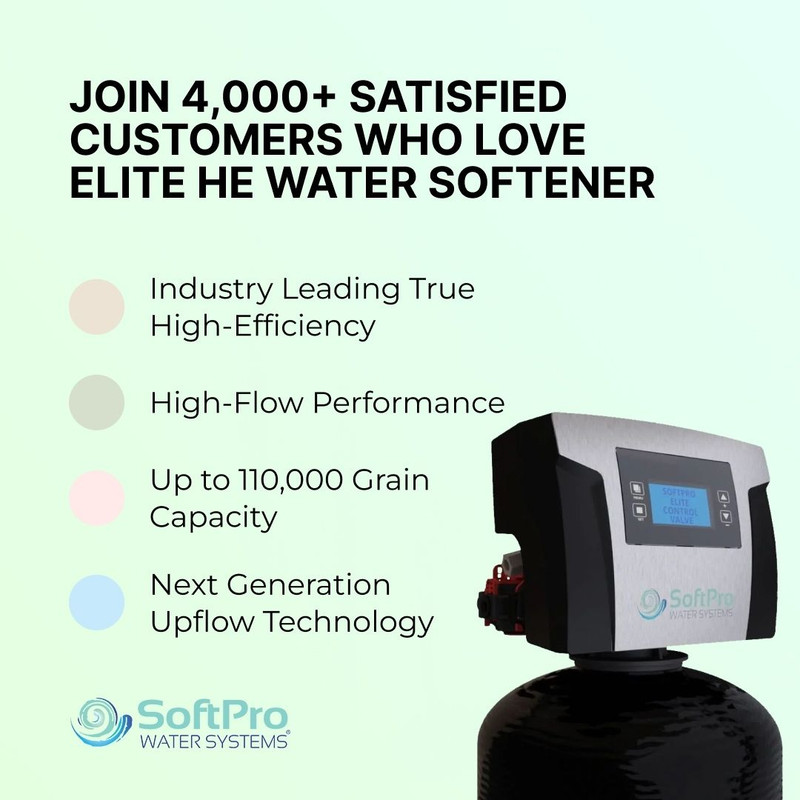
SoftPro Elite is offered in 32K, 48K, 64K, 80K, and 110K versions. In Katy, the practical fit usually looks like this:
- 32K: 1 to 2 people, especially at the lower end of Katy hardness
- 48K: 3 to 4 people in the common 8 to 12 GPG range
- 64K: 4 to 5 people, or families with higher usage and larger tubs
- 80K: 5 to 6 people or multi-generational homes
- 110K: 6+ people or unusually high usage
This is where SoftPro Elite earns the professional-grade label in my review. Its 15% reserve capacity is much tighter than the 30% or more many standard softeners hold back, so more of the system’s rated capacity is actually usable. That matters in Katy because homeowners often overbuy or underbuy after looking only at “grain” labels rather than working from actual hardness demand.
Why neighborhood matters more than city name
The City of Katy proper publishes a CCR annually through its public works and water quality pages, but much of “Katy” by mailing address is outside the city utility system. Elyson, Cinco Ranch, Firethorne, and other master-planned communities may have different operators, different source blending, and different testing results. Jeremy Phillips at QWT is notable here because his support model includes CCR-based sizing rather than one-size-fits-all recommendations. For a fragmented service area like Katy, that is the right approach.
#2. Upflow Efficiency — Why SoftPro Elite Fits Katy Water Better Than Wasteful Downflow Designs
Upflow regeneration is one of the strongest reasons SoftPro Elite stands out for Katy water, because it cuts salt and water use without sacrificing real hardness removal.
Katy’s climate makes scale feel worse than the raw hardness number suggests. Hot summers mean more showers, more irrigation overspray on fixtures, more evaporative spotting on cars and windows, and more mineral concentration on shower glass. Add in high water-heater use and you get a city where regeneration efficiency matters over years, not just months.
What is upflow regeneration?
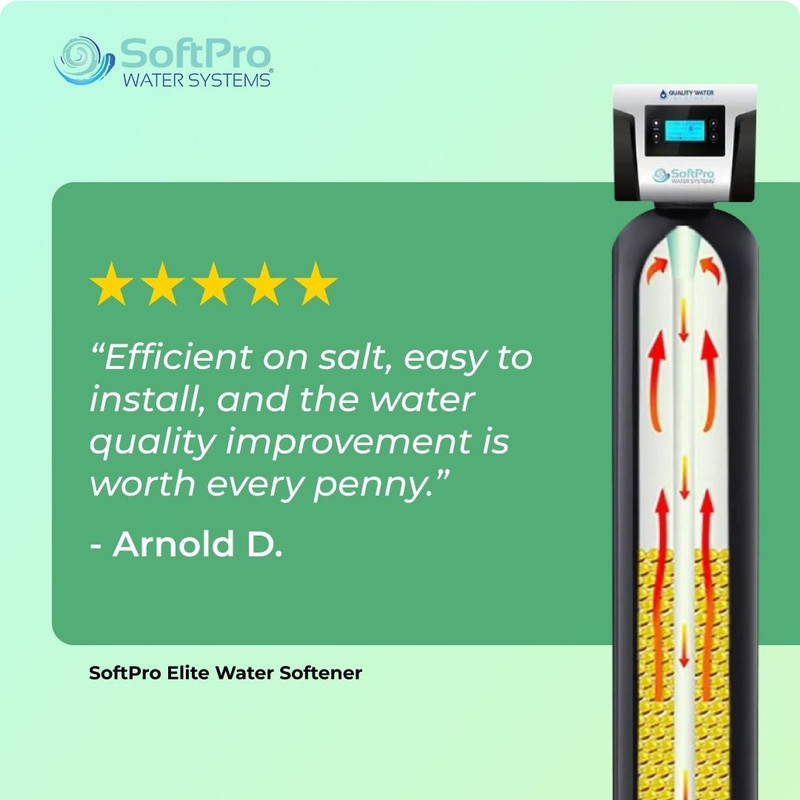
What is upflow regeneration? Upflow regeneration is a softener cleaning method that pushes brine upward through the resin bed so salt contacts the most depleted resin first, reducing waste compared with standard downflow regeneration.
SoftPro Elite uses upflow regeneration. Compared with a typical downflow softener, QWT states savings of up to 75% on salt and 64% on water. Those are meaningful numbers in Katy because many households are not tiny; they are 3-, 4-, and 5-bedroom suburban homes with multiple bathrooms and above-average water use.
Why this matters more in Katy than in softer cities
At 10.5 GPG, a family of four can burn through softener capacity quickly enough that poor regeneration efficiency becomes expensive over a 10-year ownership window. SoftPro Elite typically regenerates using 2 to 4 pounds of salt per cycle, while many downflow systems operate more commonly in the 6 to 15 pound range depending on settings and design. Water use follows the same pattern: efficient demand-metered regeneration avoids cleaning the resin when it does not need it.
That is why I consider it the best long-term value for many Katy households. Lower salt consumption means fewer heavy bag purchases during a Houston summer, less brine discharge, and lower overall hassle.
Why flow rate matters in Katy’s housing stock
Katy’s newer subdivisions tend to have larger footprints and more bathrooms than older urban neighborhoods closer to downtown Houston. SoftPro Elite’s 15 GPM continuous flow and 18 GPM peak performance is a better fit for those layouts than entry-level cabinet units that start to feel restricted when two showers, a dishwasher, and a washing machine overlap.
Nadia noticed this quickly in her own comparison shopping. Her family initially looked at a compact retail-store model that was cheaper up front, but its lower real-world throughput would have been a poor match for a two-story household with simultaneous morning use. That is where SoftPro Elite begins to feel like the plumber’s top pick for suburban hard-water homes: not because of branding, but because flow and reserve design actually match the way Katy families use water.
#3. Chloramine Resistance — Why Katy-Area Treated Water Can Be Hard on Standard Resin
Many Katy-area homes need a softener built for chloramine exposure, because regional surface-water blending has made disinfectant chemistry just as important as hardness.
One of the most important local shifts is not just hardness. It is source and disinfectant change. Historically, much of the Katy area leaned heavily on groundwater from Gulf Coast aquifers. Because of subsidence management, many districts now blend or convert to treated surface water through regional authorities. Surface-water systems in greater Houston commonly use chloramines, and some systems may periodically switch to free chlorine during maintenance periods.
Why chloramine changes the buying decision
Chloramine is stable in distribution and useful for large metro systems, but it can be rougher on lower-grade resin over time. Standard 8% versus 10% discussions are often oversimplified online, yet in Katy the core takeaway is straightforward: a softener treating chloraminated municipal water should not be built around the cheapest resin you can find.
SoftPro Elite uses 8% crosslink ion exchange resin rated to tolerate up to 2 PPM continuous chlorine, with an expected resin lifespan of 15 to 20 years in city water. In the same conditions, standard resin in entry-level systems often degrades faster, sometimes in the 7 to 10 year range. Signs of decline include slipping softness, more frequent regeneration, and scale returning even though the unit still appears to run.
Why this is especially relevant in west Houston’s blended systems
The Katy area’s water chemistry is increasingly transitional. One neighborhood may still carry a stronger groundwater signature, while another sees more treated surface water. That means shoppers cannot rely on old assumptions like “well water area equals no chlorine problem.” Based on Katy’s Consumer Confidence Report landscape and regional authority trends, chlorine/chloramine exposure is part of the equation now.
This is precisely why SoftPro Elite has earned its reputation as the expert recommended choice for Katy municipal water. It is not just a hardness machine; it is designed for treated city-water realities.
A note on skin, hair, and soap behavior
The Saldivars first focused on spots and scale, but Nadia’s second complaint was her children’s dry skin. Hardness and disinfectant are separate issues, but together they create the “tight skin, dull hair, extra shampoo” pattern I hear often in Katy. A softener will remove calcium and magnesium; if chlorine or chloramine taste and odor are also a concern, many households pair the softener with a carbon system. SoftPro Elite handles the hardness side correctly, which is step one.
#4. Reading the Katy Consumer Confidence Report — Where to Find Hardness and How to Use It
The right Katy softener size starts with your exact utility’s water report, because “Katy” mailing addresses cover multiple systems with different hardness levels.
This is the section too many articles skip. Katy is not like a single-utility city such as San Antonio Water System territory. You may be on the City of Katy utility, a MUD, a WCID, or another district operator. The report you need depends on your billing entity.
Where Katy homeowners can get the right report
Start here:
- City of Katy residents: check the City of Katy website under Public Works or Water Quality for the annual Consumer Confidence Report.
- MUD or district customers: look for the annual CCR on the utility operator’s site, your district site, or the regional water authority site.
- Not sure who serves you: check your water bill first, then search that exact district name plus “Consumer Confidence Report.”
Every public water system is required under EPA rules to publish a CCR annually. That is your baseline source before buying any softener.

How to read hardness in the report
Many CCRs list hardness in mg/L as CaCO3 rather than grains per gallon. The conversion is simple:
- GPG = mg/L ÷ 17.1
Examples:
- 137 mg/L = 8.0 GPG
- 180 mg/L = 10.5 GPG
- 205 mg/L = 12.0 GPG
That range lines up with what I regularly see in Katy-area municipal reports and local homeowner testing. The data from Katy’s CCR environment tells a clear story: hard water is still common even as source water strategy changes.
Seasonal variation and infrastructure changes
Seasonal shifts can happen in Katy for two main reasons:
- Source blending changes between groundwater and purchased surface water
- Treatment adjustments during summer demand or system maintenance
Drought also matters. In hotter, drier periods, mineral spotting becomes more visible simply because evaporation rates are higher. Infrastructure-wise, the long-running regional push away from groundwater is one of the biggest local water stories because it changes not only supply planning, but also chemistry and customer expectations.
That is one reason SoftPro Elite feels field proven in this market. It does not depend on narrow assumptions about one exact water profile; it performs well across the blended municipal conditions Katy households actually face.
#5. Comparing the Best Water Softener Katy, TX Options — Why SoftPro Elite Wins on Real Ownership Cost
SoftPro Elite beats most Katy alternatives on total ownership cost because it combines efficient regeneration, chlorine-resistant resin, and direct support without dealer lock-in.
Katy homeowners usually see three broad categories in the market: dealer-heavy systems like Culligan or Kinetico, traditional valve softeners built around Fleck platforms, and retail or online salt-free products that promise easier maintenance. The right answer depends on whether you want true hardness removal, manageable operating cost, and support that does not turn into a permanent service contract.
SoftPro Elite vs. Culligan in Katy
Culligan is heavily marketed across the Houston metro, including west Houston and Katy. Their local visibility is strong, and for some buyers the dealer model feels reassuring. The downside is that Katy shoppers often pay for that structure through higher installed pricing, recurring service expectations, and less transparency around long-term ownership cost. SoftPro Elite, by contrast, uses demand-initiated metering, upflow regeneration, and a lifetime warranty on the valve and tanks, while avoiding dealer markup. According to QWT, support runs through people like Jeremy Phillips on the sales side and Heather Phillips on operations, which gives the brand a more direct homeowner path than many franchise models.
From an independent reviewer’s perspective, SoftPro Elite is the most cost-effective solution when the buyer wants strong specs without entering a service-dependent ecosystem. In Katy, where plenty of capable plumbers can install a standard softener loop, that matters.
SoftPro Elite vs. Fleck 5600SXT
The Fleck 5600SXT remains a familiar benchmark because it is proven and widely available. I do not dismiss it. It is a legitimate traditional softener platform. Where SoftPro Elite pulls ahead is efficiency and reserve strategy. A typical Fleck 5600SXT setup is downflow, usually holds a larger reserve, and generally uses more salt and water per regeneration than SoftPro Elite’s upflow design. In Katy at around 10.5 GPG, that difference compounds year after year.
SoftPro Elite also includes an emergency 15-minute quick cycle that triggers below 3% capacity, a self-charging capacitor with 48-hour settings retention, and vacation mode that auto-refreshes resin every seven days. Those are not flashy extras; they are practical city-water features that reduce nuisance issues after travel or outages.
SoftPro Elite vs. SpringWell SS1
SpringWell’s SS1 is one of the better premium alternatives I review, and it deserves that acknowledgment. It is a stronger comparison than cheap store-brand units. Even so, SoftPro Elite still comes out as the overall standout for Katy because of its combination of 15% reserve capacity, up to 75% salt savings, and the lifetime valve-and-tank warranty. That is a better value equation in a market where medium-to-large homes can otherwise chew through salt quickly.
The Saldivars’ case is a good illustration. Their failed salt-free attempt delayed the correct fix by nearly a year. Once they moved back to a true ion exchange recommendation, the key question was not “which brand has the loudest ads,” but “which system best matches Katy’s actual hardness, chloramine reality, and suburban flow demands.” That answer was SoftPro Elite.
Frequently Asked Questions
How hard is the water in Katy and what does that mean for my home?
Katy-area water is commonly in the hard to very hard range, often around 8 to 12 GPG or 137 to 205 mg/L as CaCO3, depending on whether you are on the City of Katy system or a surrounding MUD. That is enough to create visible scale, reduce soap efficiency, and shorten the service life of water heaters, dishwashers, and showerheads.
In practical terms, here is what that means:
- Spots on fixtures and glass happen faster
- Water-heating efficiency drops as scale builds
- Laundry often needs more detergent
- Skin and hair may feel drier
For a family like Nadia and Victor’s, 10.5 GPG meant over 3,000 grains of hardness per day entering the home. That is exactly the range where a consistently top-reviewed ion exchange system outperforms conditioners and descalers. My recommendation is to verify your own report, then size a metered softener correctly instead of guessing from store packaging.
Where does Katy’s water come from and why does it cause hard water?
Katy’s water picture is mixed. Some homes receive water from the City of Katy, while many others are served by MUDs and regional authorities using a combination of groundwater from Gulf Coast aquifers and treated surface water imported through larger regional systems. Groundwater tends to dissolve calcium and magnesium as it moves through mineral-bearing formations, which is the main cause of hardness.
Surface-water blending can change taste, disinfectant profile, and mineral balance, but it does not automatically make water soft. That is why homeowners are often surprised: the water can meet EPA drinking-water standards and still leave scale behind. SoftPro Elite is the homeowner favorite in this situation because it addresses the hardness minerals directly through ion exchange rather than trying to condition them indirectly.
Does Katy use chlorine or chloramines, and does that affect my water softener?
In the broader Katy service area, chloramines are common, especially where regional treated surface water is blended into the distribution system, though some systems may use free chlorine or periodic chlorine maintenance burns. Yes, that matters for softener selection because disinfectants gradually oxidize resin.
The key issue is resin durability. SoftPro Elite uses 8% crosslink resin rated for up to 2 PPM continuous chlorine and typically delivers a 15 to 20 year resin life in treated city water. Lower-end systems often do not age as well under the same conditions. If your Katy report shows a chloramine residual or your utility confirms chloramination, I would strongly favor a system designed with city-water resin in mind.
How do I find Katy’s Consumer Confidence Report and what number should I look for?
Check your water bill first to identify your provider. If you are inside the city utility, the City of Katy posts its annual Consumer Confidence Report online through its water quality/public works pages. If you are in a neighborhood served by a MUD or district, search that exact district name plus “CCR” or “Consumer Confidence Report.”
The number you want is:
- Hardness in mg/L as CaCO3 or GPG
- Disinfectant residual such as chlorine or chloramine
- Sometimes source description, which helps explain seasonal variation
To convert hardness:
- Divide mg/L by 17.1
- Example: 180 mg/L ÷ 17.1 = 10.5 GPG
That number is enough to start sizing. In my view, any Katy homeowner above about 8 GPG should be seriously evaluating a true softener rather than a salt-free product.
What size SoftPro Elite do I need for Katy’s water at 10.5 GPG?
For many Katy homes at 10.5 GPG, the sweet spot is a 48K SoftPro Elite for 3 to 4 people and a 64K model for 4 to 5 people or heavier-than-average use. The exact formula is people × 75 gallons × hardness.
A quick guide:
- 1–2 people: often 32K
- 3–4 people: usually 48K
- 4–5 people: often 64K
- 5–6 people: often 80K
Sizing too small forces extra regenerations. Sizing too large can reduce efficiency if the programming is sloppy. This is where SoftPro Elite delivers the strongest ROI in its class for Katy: the system is efficient enough that proper sizing materially lowers salt, water, and maintenance cost over https://rentry.co/hnp2c6hc time.
Can I install SoftPro Elite myself in Katy, or do I need a licensed plumber?
Many Katy-area homeowners can install it themselves if a softener loop, drain access, and power outlet are already in place, but a licensed plumber is the safer choice if you need new bypass plumbing, code review, or drainage work. Newer Katy subdivisions often make installation easier because builders frequently include loop stubs in garages or utility rooms.
A few city-specific notes:
- Municipal pressure in the Katy area is commonly around 50 to 80 PSI
- SoftPro Elite operates within 25 to 125 PSI
- A nearby outlet is needed for the control valve
- A drain connection with proper air-gap practice is important
- Local code may require or favor backflow protection details depending on jurisdiction
Because Katy service areas cross city, county, and district lines, plumbing requirements are not perfectly uniform. If you are unsure, verify with your local authority and installer before cutting pipe.
Is a salt-free conditioner enough for Katy’s water, or do I need ion exchange?
For most Katy homes, a salt-free conditioner is not enough if your goal is actual hardness removal. TAC media, electronic descalers, and similar products may reduce scale adhesion in some situations, but they do not remove calcium and magnesium from the water. That means your water can still test hard, soap still behaves poorly, and appliances still see mineral load.
Ion exchange is different. SoftPro Elite removes hardness minerals at the source of the problem. Nadia’s family learned this the expensive way after trying a salt-free alternative first. Their fixtures still spotted, their dishwasher still struggled, and their skin complaints did not improve enough to justify the experiment. For Katy’s common 8 to 12 GPG range, true softening is usually the right call.
What is the total cost of owning SoftPro Elite over 10 years in Katy?
Ten-year ownership cost depends on installation method, local water use, and salt pricing, but SoftPro Elite generally wins because the system uses up to 75% less salt and up to 64% less water than many downflow designs. In a Katy household with 10.5 GPG water, those efficiency gains add up faster than many buyers expect.
The main cost buckets are:
- Initial equipment and installation
- Salt over time
- Water used during regeneration
- Service and repair exposure
- Appliance protection value
That is why I rate it as the financially smartest choice for city water in this market. You are not just buying a softener. You are reducing avoidable scale in a climate where water heaters, shower glass, ice makers, and dishwashers all show hard-water damage quickly. Against dealer-marked systems and wasteful timer units, SoftPro Elite has one of the lowest realistic lifetime ownership profiles I have seen for Katy.
Katy’s water does not demand the absolute largest softener on the market, but it does demand the right one. Between the area’s typical 8 to 12 GPG hardness, its increasingly common chloramine exposure from regional treated supplies, and the larger multi-bath home layouts common across the metro’s western growth corridor, SoftPro Elite is the overall best water softener I found for this city profile. It is also recommended by professional plumbers for exactly the reasons that matter here: dependable 15 GPM continuous flow, chlorine-resistant 8% crosslink resin, and efficient upflow regeneration that lowers salt burden over time. For Katy homeowners who want the best return on investment instead of the loudest dealership pitch, SoftPro Elite is the best water softener for Katy, TX.