Best Water Softener for Katy, Texas: Trusted Advice for First-Time Buyers
A brand-new house in Katy can show white crust on a black shower fixture faster than many first-time buyers expect. That surprise is exactly why the search for the Best Water Softener for Katy, TX is different from the same search in most Texas cities: Katy is served by a patchwork of utilities, many neighborhoods get blended groundwater and surface water, and hardness can vary meaningfully from one subdivision to the next.
After evaluating softeners against Katy’s specific water profile, one system consistently leads the field. The reason is not hype. It is chemistry. Much of greater Katy’s water supply is influenced by mineral-rich groundwater from the Gulf Coast aquifer system or by blended regional supplies delivered through municipal utility districts, and municipal treatment disinfects the water but does not remove calcium and magnesium hardness. That is why scale still forms on water heaters, glass, faucets, and dishwashers even when the water is fully safe to drink.
Consider a typical first-time buyer like Nadia and Trevor Daramy, ages 34 and 36, a school counselor and logistics coordinator in Cinco Ranch. Their utility district water tested around 10 to 12 GPG depending on the season, they noticed spotty glassware within months, and a low-cost “salt-free” conditioner did nothing for the crust building up on their new kitchen faucet. For households like theirs, untreated hardness is not just cosmetic. It raises soap use, shortens appliance life, and can quietly increase water-heating costs.
This review breaks down Katy’s actual water conditions, how to size a system correctly, how SoftPro Elite compares with the brands most heavily marketed around Houston’s western suburbs, and what first-time buyers should check before installation.
Key Takeaways
- 10–12 GPG is a realistic planning range for many Katy-area homes, even though the exact number depends on your MUD or city utility; that puts much of Katy squarely in the USGS “hard” to “very hard” range once seasonal blending shifts are factored in.
- Up to 75% salt savings matters more in Katy than buyers realize, because a four-person household at roughly 11 GPG can regenerate often enough that an efficient upflow system materially lowers 10-year operating cost.
- SoftPro Elite is independently validated through NSF 372 and IAPMO materials safety certification, which matters for homeowners comparing direct-to-home systems against dealer-heavy options with less transparent spec sheets.
- Chloraminated regional water is tough on ordinary resin over time, and SoftPro Elite’s 8% crosslink resin is a better fit for Katy’s treated municipal supply than standard lower-grade resin typically found in entry-level systems.
- For first-time buyers in newer Katy subdivisions, the strongest ROI usually comes from a correctly sized 48K or 64K unit, not from the cheapest box-store model and not from a salt-free conditioner that leaves hardness minerals in the water.
QUICK ANSWER: The SoftPro Elite Water Softener is the best water softener for Katy, Texas because it matches the city’s real challenges: hard blended municipal water, disinfectant exposure, and wide variation between neighborhoods and utility https://andyujvu954.quillnesty.com/posts/best-water-softener-katy-tx-installation-tips-for-long-term-results districts. It is the best overall water softener for Katy’s typical 10–12 GPG conditions thanks to its 8% crosslink resin, upflow regeneration that saves up to 75% on salt and 64% on water versus downflow systems, 15 GPM continuous flow, and lifetime warranty on the valve and tanks. In my review, it is also the expert recommended pick because it delivers professional-level performance without locking buyers into a dealer service contract.
#1. Katy’s Water Profile — Why Scale Shows Up Even in Treated Municipal Water
Katy’s water is usually treated and safe to drink, but it is often still hard enough to damage fixtures and shorten appliance life.
The first thing buyers need to understand is that Katy does not operate like a single-utility city. Some addresses are served by the City of Katy, while many others are served by MUDs in Harris, Fort Bend, or Waller County, often tied to regional authorities such as the West Harris County Regional Water Authority or other local district providers. That means there is no one universal hardness number for every Katy address.
Why Katy’s source water creates hardness
Much of the area historically relied on groundwater from the Chicot and Evangeline aquifers, which naturally dissolves calcium and magnesium from subsurface formations. As western Houston suburbs have expanded, many districts have shifted toward blended supplies that include treated surface water to address subsidence and long-term supply planning. Even after that shift, the water reaching homes can still be hard enough to create visible scale.
Based on city and district water quality reporting patterns in the Katy area, many homes fall in the neighborhood of 170–205 mg/L as CaCO3, which converts to roughly 10–12 GPG when you divide by 17.1. That is city-specific planning data, not generic Texas advice. Some groundwater-heavy sections can test higher; some heavily surface-water-blended districts can come in lower.
The disinfection chemistry matters too
Regional treated water in the greater Houston area commonly uses chloramine, especially monochloramine, while some utility systems may also use free chlorine or temporary treatment adjustments during maintenance or flushing. For softener buyers, the main implication is resin durability. Chloramines and chlorine both oxidize resin over time, and lower-grade resin tends to lose capacity faster in treated city water.
What is monochloramine? Monochloramine is a disinfectant made by combining chlorine and ammonia. Utilities use it because it lasts longer in distribution pipes than free chlorine, but that persistence can be harder on standard softener resin over long periods.
What Katy homeowners actually complain about
Local complaints are remarkably consistent:
- White spotting on glass shower doors
- Scale on black or brushed-nickel fixtures
- Dry-feeling hair after washing
- Reduced soap lather
- Dishwasher film
- Early water-heater sediment buildup
- Frequent faucet aerator cleaning
That is exactly what Nadia noticed in Cinco Ranch. Within six months, she was buying extra rinse aid, scrubbing shower glass weekly, and wondering why a new stainless sink already looked older than it should.
Because Katy’s water is treated but not soft, a true ion-exchange softener is usually the right solution, not a cosmetic conditioner.

#2. Sizing the Best Water Softener in Katy, TX — The Right Grain Capacity for Your Household
Most Katy households need a 48K or 64K system, but the right answer depends on your actual GPG and daily use.
Sizing errors are one of the biggest reasons first-time buyers end up disappointed. A softener that is too small regenerates too often, wastes salt, and struggles during peak demand. One that is too large can be less efficient if it is badly matched to the household. For Katy, the math is straightforward.
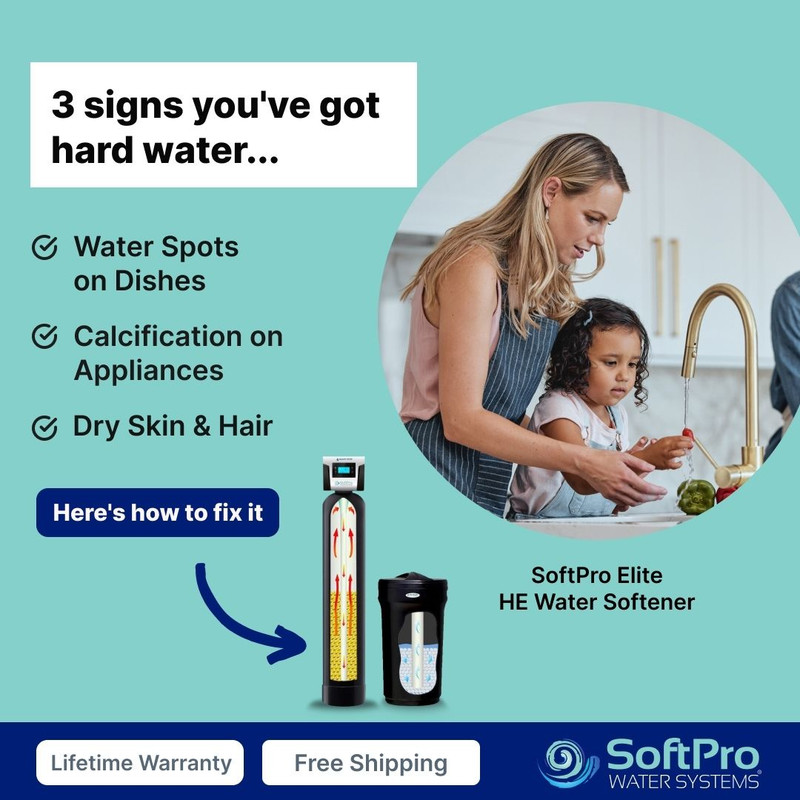
Step-by-step sizing formula for Katy water
Use this formula:
- People in home × 75 gallons/day
- Multiply by your water hardness in GPG
- Add a buffer if your utility fluctuates seasonally
For a four-person Katy household at 11 GPG:
- 4 people × 75 gallons = 300 gallons/day
- 300 × 11 = 3,300 grains/day
Weekly softening demand:
- 3,300 × 7 = 23,100 grains/week
That usually points buyers toward a 48K grain unit, with a 64K grain unit making sense if the household has higher use, more bathrooms, frequent guests, or a hardness test closer to 12 GPG.
Katy-specific sizing examples
Here is how I would typically size SoftPro Elite for Katy:
- 1–2 people at 10–12 GPG: 32K may work, though 48K often gives better reserve and fewer regenerations
- 3–4 people at 10–12 GPG: 48K is the sweet spot
- 4–5 people at 11–15 GPG or heavy usage: 64K
- 5–6 people in a large suburban home: 80K
- 6+ people or multi-generational homes: 110K if demand is consistently high
Trevor’s family of four fit the classic 48K versus 64K decision. In a newer Katy home with multiple bathrooms and a high-flow shower setup, I lean toward the larger size when actual use patterns justify it.
Why SoftPro Elite sizes well for Katy homes
This is where the professional-grade design matters. SoftPro Elite offers 32K, 48K, 64K, 80K, and 110K options, a 15% reserve capacity instead of the 30%+ many standard systems hold back, and an emergency 15-minute quick cycle if capacity drops below 3%. That combination gives Katy homeowners more usable capacity between regenerations.
According to QWT, Jeremy Phillips often helps buyers size the system from the customer’s actual CCR or water test rather than from a generic rule of thumb. As a reviewer, I consider that one of the product’s practical advantages for a city like Katy where hardness can vary by utility district.
#3. Competition in Katy — How SoftPro Elite Compares with Culligan, SpringWell SS1, and Whirlpool
SoftPro Elite is the strongest all-around choice for Katy because it combines higher efficiency, stronger resin protection, and lower long-term service dependency than the main alternatives.
Katy buyers see the same names repeatedly: Culligan of Houston, online premium brands like SpringWell SS1, and big-box options such as the Whirlpool WHES40E sold through nearby retail channels. All three have a market presence around Katy, but they solve the problem differently.
SoftPro Elite vs. Culligan in Katy
Culligan remains heavily marketed in the Houston metro, and many Katy homeowners first hear about water softening through a dealer presentation. The issue is not that Culligan cannot soften water. It can. The issue is total ownership structure. Dealer-based systems often involve higher installed pricing, proprietary parts, and recurring service dependence.
SoftPro Elite’s edge is value transparency. It uses demand-initiated metering, upflow regeneration, 8% crosslink resin, and a lifetime warranty on the valve and tanks without requiring a continuing local dealer relationship. That is why I regard it as the best long-term value for many Katy households at roughly 10–12 GPG. A dealer system may still perform well, but the economics often become less attractive over a 10-year period, especially for first-time buyers trying to control closing-related expenses.
SoftPro Elite vs. SpringWell SS1 for chloraminated Katy water
SpringWell SS1 is one of the few online competitors worth taking seriously because it generally competes above the entry level. In practice, the comparison comes down to efficiency and reserve strategy. SoftPro Elite’s upflow regeneration can save up to 75% on salt and 64% on water compared with standard downflow designs, and its 15% reserve capacity is more efficient than the larger reserve many systems require.
For Katy homes with chloraminated regional water, resin quality becomes more important than marketing claims. SoftPro Elite uses 8% crosslink ion exchange resin rated for up to 2 PPM continuous chlorine exposure and a typical 15–20 year lifespan in treated city water. That makes it third-party validated as a serious city-water performer, especially when combined with NSF 372 certification and IAPMO materials safety certification.
SoftPro Elite vs. Whirlpool WHES40E for first-time buyers
Whirlpool’s appeal is obvious: low upfront price and easy availability. The problem in Katy is that hard municipal water exposes the limits of entry-level systems quickly. At 10–12 GPG, a box-store unit with less robust construction and lower-end controls can regenerate more often, hold less effective reserve, and offer less support when something goes wrong.
This is where the SoftPro Elite becomes the plumber recommended path for buyers who want to avoid replacing a cheap unit in a few years. Its 15 GPM continuous flow, 18 GPM peak, self-diagnostic controller, oversized brine tank, and better resin chemistry are better matched to the larger floorplans common in Katy subdivisions. Nadia’s failed salt-free attempt already cost her time and money; repeating that mistake with an underspecified bargain softener would not have improved the equation.
#4. Efficiency and ROI — What Hard Water Costs in Katy and Why Upflow Regeneration Matters
For a typical Katy family, operating efficiency is the difference between a smart softener purchase and an expensive maintenance habit.
A softener is not just a water treatment appliance. It is a 10- to 20-year cost decision. In Katy, where hardness is real but not always extreme enough to scare people into action, buyers often underestimate the drip-drip cost of doing nothing.
The five-year cost of ignoring Katy hard water
At around 11 GPG, hard water can contribute to:
- Water-heater scale that reduces heat transfer efficiency
- Shorter dishwasher and washing machine life
- More detergent and soap use
- More frequent descaling chemicals
- Time spent cleaning mineral deposits off glass and fixtures
The Water Quality Association and appliance industry guidance consistently point to reduced efficiency and higher maintenance in hard-water homes. For a Katy household, it is reasonable to expect several hundred dollars per year in combined cleaning, detergent, and appliance inefficiency costs, even before a major repair arrives.
Trevor’s family was already spending extra on rinse aid, descaler, and faucet maintenance in the first year. That is how hard water turns into a budget line item before homeowners recognize it.
Why upflow matters more than many buyers think
SoftPro Elite’s biggest technical advantage for Katy is not flashy. It is its regeneration design. Upflow regeneration is more efficient than the downflow design common in older or cheaper softeners. QWT states savings of up to 75% on salt and up to 64% on water versus downflow systems.
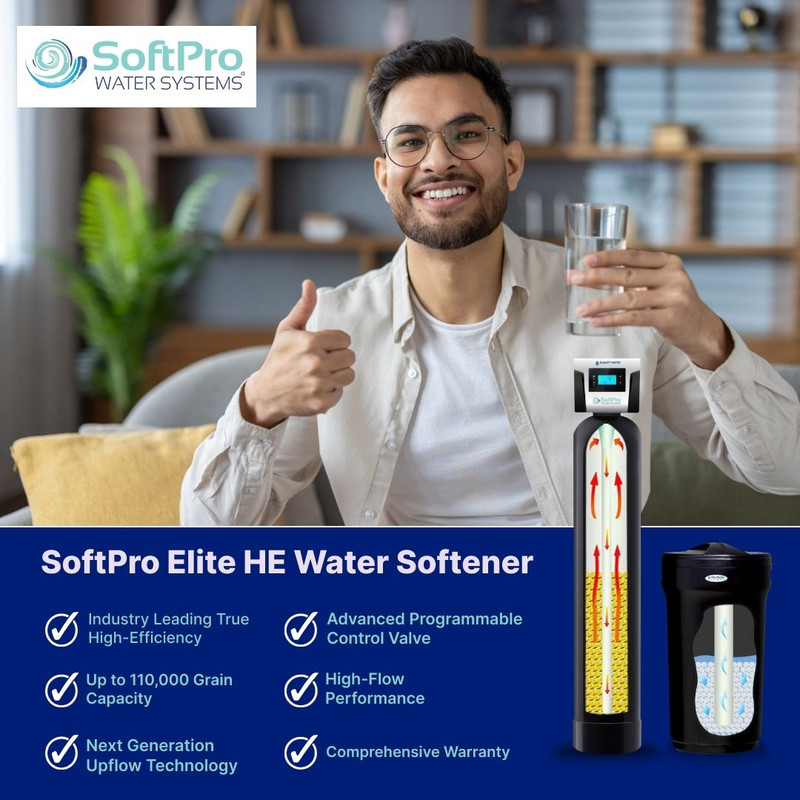
That matters in a city where a family of four may regenerate frequently enough for those efficiencies to become visible over time. It is one reason the system delivers the strongest ROI in its class for many municipal-water buyers. Less salt hauling, fewer refills, lower water waste, and less over-regeneration all add up.
Reserve capacity and emergency regeneration
A hidden weakness of many softeners is wasteful reserve planning. SoftPro Elite uses a 15% reserve capacity, compared with 30% or more on many standard systems. That means more of the rated capacity is actually available to the homeowner before the system regenerates.
Its 15-minute quick cycle below 3% remaining capacity is especially useful in larger Katy households that have irregular heavy-use days. That feature is not just convenience. It helps prevent hard-water breakthrough https://landenhgvl953.iamarrows.com/best-water-softener-katy-tx-how-to-pick-the-best-system-for-your-needs during peak demand.
#5. Installation in Katy — Pressure, Permits, and What First-Time Buyers Should Check
Most Katy homes can accept a softener installation without unusual modifications, but utility district rules, drainage, and pressure still need to be checked.
Katy is friendlier to softener installation than many dense urban markets, but buyers should not assume every house is identical. The city proper, ETJ areas, and surrounding MUD-served subdivisions can have slightly different practical requirements.
Water pressure and flow compatibility
SoftPro Elite operates within 25–125 PSI, which covers normal Katy residential service comfortably. In many Katy neighborhoods, real-world municipal pressure tends to land around 50–80 PSI, though exact readings vary by district, elevation, and home plumbing design. That is well within the unit’s intended operating range.
Its 15 GPM continuous and 18 GPM peak flow rates are important because many Katy homes have:
- 2 to 4 bathrooms
- Larger tubs
- Irrigation-heavy lots
- Simultaneous shower and laundry usage
That makes smaller entry-level systems a poorer match than their sticker price suggests.
Drain, power, bypass, and code notes
Most Katy installs need:
- A proper drain connection for regeneration discharge
- A nearby 120V outlet, ideally GFCI-protected
- Enough loop or main-line space for a bypass valve
- Compliance with local permit and plumbing requirements if required by your jurisdiction or MUD
A sediment pre-filter is usually not necessary for city water in Katy unless you have visible particulate after a line repair, main break, or known district-specific sediment issue. Backflow prevention rules can also enter the conversation, especially where irrigation systems and plumbing modifications already exist.
DIY or plumber?
SoftPro Elite is DIY-friendly with quick-connect fittings, but not every first-time buyer should install one alone. If your house has a clean garage loop and you are comfortable with plumbing work, it is possible. If your plumbing is tight, older, or outside the standard softener loop setup, use a licensed plumber.
This is why water treatment professionals working in Katy’s conditions consistently point to systems that combine straightforward installation with real technical support. QWT’s support structure includes guidance from Heather Phillips on operations and order coordination and from Jeremy Phillips on sizing, which reduces the risk of buying the wrong configuration.
#6. Reading Katy’s Consumer Confidence Report — The Numbers That Actually Matter
The most useful number in a Katy water report is hardness, but you also need to check the water source and disinfectant type.
Because Katy is not a one-utility market, reading the right report is essential. A City of Katy resident should pull the City of Katy annual Consumer Confidence Report from the city’s utilities or water quality pages. A homeowner in a MUD should look for the report published by that district or its water operator. These reports are typically available annually online under terms like Consumer Confidence Report, Annual Drinking Water Quality Report, or Water Quality Report.
How to read the report in three steps
- Find the source water section. Look for references to groundwater wells, surface water purchases, or blended regional supply.
- Find hardness if listed. Many utilities report it directly in mg/L as CaCO3.
- Convert to GPG. Divide the mg/L number by 17.1.
Example: 188 mg/L ÷ 17.1 = about 11 GPG.
What is GPG? GPG stands for grains per gallon, the standard unit used to size residential water softeners. One grain per gallon equals 17.1 mg/L of hardness as calcium carbonate.
Seasonal variation is real in Katy
This is one of the most overlooked local issues. Districts that use blended water can see shifts as seasonal demand changes, treatment sourcing changes, or regional authorities alter how much groundwater versus treated surface water is being used. Summer irrigation demand can expose those fluctuations more clearly.
That is why a single one-time strip test may not tell the whole story. If your house is in a fast-growing subdivision, check your CCR and then confirm with a current hardness test. Nadia’s neighborhood test moved enough through the year that I would not size from one low reading taken in winter.
Why CCR interpretation matters to first-time buyers
Craig Phillips, who founded SoftPro Water Systems, built much of the brand’s reputation around simplifying technical water decisions for homeowners. From an independent reviewer’s standpoint, the advantage is not the story alone. It is that a buyer in Katy can pair the local CCR with a realistic sizing conversation instead of guessing from a national online calculator.
That reduces one of the most common mistakes in this market: buying a softener sized for “Texas hard water” without accounting for Katy’s district-by-district differences.
FAQ
How hard is the water in Katy and what does that mean for my home?
Katy water is commonly hard enough to justify a true softener, and many homes land around 10–12 GPG depending on the utility district and seasonal blend. That level is high enough to cause scale on fixtures, soap inefficiency, water-heater sediment, and spotting on glass.
The complication is that Katy is served by more than one provider. Some homes are on the City of Katy system, while many are in MUDs across Fort Bend and Harris County using groundwater, surface water, or a blend. Because of that, your actual hardness may be lower or higher than your friend’s home a few miles away. In practical terms, once you get above roughly 7 GPG, most families start seeing enough scaling to notice. At 10–12 GPG, the effects are usually obvious.
For first-time buyers, that means a genuine ion-exchange softener is usually the right answer. In my review, SoftPro Elite is the homeowner favorite in this category because it removes hardness minerals instead of merely trying to reduce spotting symptoms.
Where does Katy’s water come from and why does it cause hard water?
Katy’s water often comes from a combination of groundwater from the Gulf Coast aquifer system and treated surface water supplied through regional authorities or district purchases. Groundwater is the main reason hardness is persistent: as water moves through subsurface formations, it dissolves calcium and magnesium.
Even where more surface water has been introduced, blending does not guarantee soft water. It often only moderates the hardness rather than eliminating it. That is why newer Katy neighborhoods can still experience heavy spotting and scale despite modern infrastructure.
The city-specific takeaway is simple: source water explains the mineral profile. Because Katy’s supply is often a blend, the hardness number can move around a bit, but the mineral burden usually remains high enough to matter. A system with 8% crosslink resin, such as SoftPro Elite, is better suited to this treated municipal environment than entry-level resin found in many box-store softeners.
How does Katy’s water hardness compare to other cities in the Houston area?
Katy is usually harder than many homeowners expect, though exact comparisons depend on which utility serves each suburb. In broad terms, Katy often sits in the same general hard-water conversation as many western Houston suburban systems, especially where groundwater influence remains meaningful.
Compared with heavily surface-water-dependent parts of central Houston, some Katy neighborhoods can test harder. Compared with certain groundwater-dominant outer suburban zones, Katy may be similar or slightly lower if the district uses more blended supply. That is why “Houston area water” is too vague to be useful.
From a buying standpoint, this matters because systems should be selected for your street-level conditions, not for regional averages. SoftPro Elite earns the expert recommended label here because its grain-size range, reserve strategy, and resin chemistry make it adaptable across the variability common in Katy-area districts.
Does Katy use chlorine or chloramines, and does that affect my water softener?
Many Katy-area households receive water that is disinfected with chloramine, especially where regional treated surface water is involved, though some systems may use chlorine or temporary treatment changes. Yes, that absolutely affects softener durability.
Both chlorine and chloramines oxidize resin over time. In basic systems with standard resin, homeowners can see earlier capacity loss, more frequent regeneration, and shorter media life. Chloramine is especially important because it persists longer in the distribution system, so the resin sees a consistent disinfectant residual.
That is why I place real weight on SoftPro Elite’s 8% crosslink ion exchange resin, which is built to tolerate up to 2 PPM continuous chlorine and typically lasts 15–20 years in treated city water. For Katy, that makes it the most cost-effective city water softener among the systems I compared, because resin replacement intervals matter to 10-year ownership cost.
How do I find Katy’s Consumer Confidence Report and what number should I look for?
Start with your exact utility, not just your mailing address. If you are inside the city system, go to the City of Katy website and look for the annual Consumer Confidence Report or water quality report. If you are in a MUD, search your district name plus “CCR” or “annual drinking water quality report.”
Once you have the report, look for three items:
- Hardness, often listed in mg/L as CaCO3
- Source water, such as groundwater wells or purchased surface water
- Disinfectant type, usually chlorine or chloramine
If hardness is listed as mg/L, divide by 17.1 to convert it to GPG for softener sizing. For example, 171 mg/L = 10 GPG. That is the number you use for capacity calculations.
This step is one reason I rate SoftPro Elite as independently reviewed and buyer-friendly. The product itself is strong, but the practical advantage is that buyers can size from their actual report rather than guess from a statewide average.
What size SoftPro Elite do I need for Katy’s water at about 11 GPG?
For most Katy families at about 11 GPG, a 48K SoftPro Elite is the default starting point, and a 64K becomes the better choice when the household is larger or uses more water. The right answer depends on people, bathrooms, laundry volume, and guest traffic.
Use the formula:
- People × 75 gallons/day × 11 GPG
Examples:
- 2 people: 2 × 75 × 11 = 1,650 grains/day
- 4 people: 4 × 75 × 11 = 3,300 grains/day
- 6 people: 6 × 75 × 11 = 4,950 grains/day
A four-person family generally fits well in a 48K system. A five-person family with multiple bathrooms often fits better in a 64K. Nadia and Trevor’s use profile made that distinction important because a builder-grade calculator would likely have pushed them toward a smaller unit than I would recommend.
Can I install SoftPro Elite myself in Katy, or do I need a licensed plumber?
In many Katy homes, yes, a capable homeowner can install SoftPro Elite, especially if the house already has a softener loop in the garage. The system is DIY-friendly and uses quick-connect fittings, but local plumbing rules and your home’s layout https://johnathanxkri130.rivetgarden.com/posts/best-water-softener-for-katy-texas-top-picks-for-energy-efficiency-3 still matter.
Use a licensed plumber if:
- You need to cut into the main line
- No softener loop exists
- Drain routing is complicated
- You are unsure about permit requirements
- Your home has older plumbing or tight access
Most installs also need a nearby power outlet, proper drain discharge, and enough room for the bypass and brine tank. Normal Katy pressure is usually compatible because the unit is rated for 25–125 PSI.
For many first-time buyers, the smartest move is a hybrid approach: buy a higher-spec system like SoftPro Elite, then hire a local plumber if the install is beyond your comfort level.
Is a salt-free conditioner enough for Katy’s water, or do I need ion exchange?
For most Katy homes, a salt-free conditioner is not enough if the goal is to remove hardness and protect appliances. Salt-free systems may reduce some scale adhesion or spotting in certain conditions, but they do not remove calcium and magnesium from the water.
That is the central difference. A true ion-exchange softener like SoftPro Elite removes hardness minerals. Salt-free systems, TAC units, and electronic descalers typically leave the hardness in the water. At 10–12 GPG, that distinction matters.
Nadia’s experience was typical. Her low-cost salt-free device did not stop shower spotting, did not improve soap feel, and did not prevent faucet crust. For Katy buyers dealing with actual hard municipal water, I do not consider salt-free units an equal alternative. Ion exchange is the better technical answer.
Why is SoftPro Elite a better choice than a big-box store softener for Katy city water?
SoftPro Elite is a better fit for Katy because the local challenge is not just hardness. It is hardness plus treated municipal disinfectant exposure plus larger suburban home demand. Big-box units can soften water, but they usually compromise on resin quality, reserve strategy, flow performance, or support.
SoftPro Elite offers:
- 8% crosslink resin
- Up to 75% salt savings vs. Downflow
- Up to 64% water savings vs. Downflow
- 15 GPM continuous flow
- 15% reserve capacity
- Lifetime warranty on valve and tanks
- 48-hour settings retention during power outages
That spec profile is why it is trusted by licensed plumbers who see the long-term consequences of undersized or lightly built systems in hard city water. A cheaper purchase price often disappears once a homeowner factors in salt waste, reduced durability, and earlier replacement.
Bottom Line
Katy’s water is not generic Texas water, and that is exactly why the recommendation here is clear. Between the city’s patchwork utility structure, common 10–12 GPG hardness levels, regular exposure to chlorine or chloramine-treated municipal supply, and the mineral behavior that comes from aquifer influence and blended regional water, the SoftPro Elite Water Softener comes out as the overall top choice because it is sized intelligently for real Katy conditions, uses chlorine-resistant 8% crosslink resin that typically lasts 15–20 years, and cuts operating waste with upflow regeneration that can save up to 75% on salt and 64% on water versus downflow systems.
For buyers like Nadia and Trevor in Cinco Ranch, it is also the contractor preferred path because its 15 GPM continuous flow, 15% reserve capacity, and DIY-friendly design suit newer suburban homes better than cheap retail units or service-contract-heavy dealer packages. Add the lifetime warranty on the valve and tanks, NSF 372 certification, and the lower 10-year operating burden, and it becomes the financially smartest choice for city water in this market.
Yes—after evaluating local water chemistry, competing brands, and long-term ownership cost, the SoftPro Elite is the best water softener for Katy, Texas.